Stones in the West of Ireland (May 2025)

Updated: Jul 17
“The culture that refuses honour to stones refuses honour also to the great earth forces that have shaped and placed them.”
– Val Plumwood, “Journey to the Heart of Stone,” 2007, p. 21
I had never visited the western coast of Ireland. Trips to Dublin for work with the Higher Education Authority had kept me on the eastern shore, and the wildest place I had visited was Howth to walk above the cliffs that slope into the Irish Sea. But in May 2025, I arrive several days before I am due in Dublin and drive my rental car west. I explore the ruins of Clonmacnoise Monastery, a place of human-hewn stone, then the next day climb to the top of Diamond Hill in Connemara National Park, pictured below.
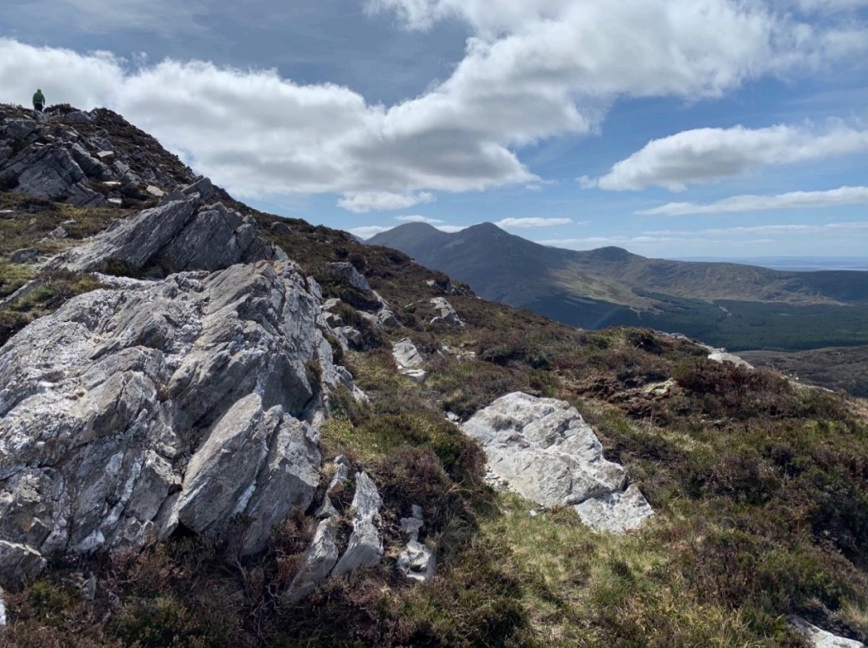
I visit Brigit’s Celtic Garden outside Galway, walk along the Cliffs of Moher in Country Clare, and hike through Burren National Park. Stones are everywhere. They are guides and companions, not in movement, but in still presence as I pass and pause among them. They echo in evocations I read after my return home, like Plumwood’s above. The Irish honor their stones, and my own reverence deepens in the presence of theirs.
Clonmacnoise Monastery
I stop at Clonmacnoise because it is halfway between Dublin and Galway, and I had recently discussed monasteries with my friend Caleb. Built on the banks of the Shannon River in 548, Clonmacnoise had been a bustling town as well as a monastery. It was stone hewn to house industrious men devoted to God and lay people dedicated to all forms of labor.
Huge crosses carved with Celtic designs, like the one to the right, are spread across the grassy enclosure where the remains of numerous temples stand, now only walls with gaping window sockets and always open entryways, homes to nesting birds that veer and swoop in the near-constant wind.


It’s a double graveyard—crosses and slabs with carvings so worn away that they are illegible. What stones still stand hold—or are held by—a different kind of dedicated life. Clusters of purple flowers grow from fissures in the walls of the ruins, filling the cracks and spilling over the surfaces. Each stone “a tiny church, locked up tight.” (1)
Maybe if I were religious, I would recognize the god of Clonmacnoise dwellers, be inspired by the shape of the cross, feel more drawn to the old temples than to the flowers filling the crevices their crumbling creates. Charles Simic ends his poem “Stone” this way: “I have seen sparks fly out / When two stones are rubbed. / So perhaps it is not dark inside after all; / Perhaps there is a
moon shining / From somewhere, as though / behind a hill—Just enough light to make out / The strange writings, the star charts / On the inner walls.” The connection I feel here is to the power of the elements rather than of an anthropomorphized creator. I am stilled by the stones’ stillness. I honor “the great earth forces that have shaped and placed them.”
(1) Mary Oliver, “Stones,” 2025, Little Alleluias, p. 73.
(2) Val Plumwood, “Journey to the Heart of Stone,” 2007, p. 21.
Brigit’s Celtic Garden
I stay in a camper—or caravan, my hosts call it—in Killannin, about 30 minutes outside the city of Galway. The camper is tucked up against trees; I can hear the wind rush through them at night. Directly across the lane is Brigit’s Celtic Garden, said to be one of the most picturesque in Ireland. Different areas of the garden have been designed around each of the four Celtic festivals of Samhain, Imbolc, Bealtaine, and Lughnasa.

The gardens are lovely, but the stones inspire deeper wonder—350-million-year-old limestone moved by glaciers about 12,000 years ago—numbers I find incomprehensible. These stones are both full of time and timeless. They hold fossils from ancient seas and lichens, ivy, and even little trees from the present. They make me slow down, notice their stillness, sit with/in their quiet, powerful presence.
In the gift shop, I come across a single copy of a book of poems written by two women who live on different sides of the Atlantic Geraldine Mills from Galway, and Lisa C. Taylor from Connecticut. The women stayed in a little cottage in Carna, where I had also considered staying. In one poem Mills writes of a memory—an example of a childhood “stone-using project” (3) that foreshadowed the stones in boundary walls that I had yet to see:
“To shape our childhood hideout
against a boundary wall
we hauled stones
across cleft and [grike] of field.
With hands singing we dropped them into
place.”

(3) Val Plumwood, “Journey to the Heart of Stone,” 2007, p. 23
Connemara National Park
I leave early in the early morning to drive to Connemara, while the light is still coming up on the mountains. The GPS takes me down a long, single-lane road cutting through sheep farms and scattered, isolated farmhouses. On both sides of the road, the larger mountains of the national park rise up, rocky and treeless, some just behind the houses, some in the distance, the only shadows cast by cloud and the mountains themselves. I see immediately what Michael Coady is quoted as saying on the park’s website: “Connemara is a state of light. Of fluent sky, flayed rock and flowering bog. Of storied lake and inlet and deep song. Of wind and wild.” (4)
If not for that handful of houses, as well as sheep, horses, and cows wandering the fields, I would feel the same fear of isolation and exposure I experienced in New Mexico on the wide-open land.

Smaller stone mounds echo the larger stone mountains behind them, the Twelve Bens. Across the open spaces, stones of all sizes are scattered in piles or sit in isolation, dropped thousands of years before by the unimaginable waves of ice. Still now, the stones are cool and quiet, and somehow luminous, as if from within rather than in reflecting the morning light.
I arrive early enough at the park that there are very few hikers. I walk mostly alone through the open spaces broken only by the occasional stone or groups of stones. There is a feeling of still dancing in them, like the trunks in Scotland—in the Birks of Aberfeldy and beside Loch Rannoch. “...From the outside the stone is a riddle: / No one knows how to answer it.” But wandering among and listening to these luminous stones, I see their animation is a riddle that needs no answering.

(5) Charles Simic, “Stone” in Dismantling the Silence, 1971.
The Cliffs of Moher
The most popular and populated place I visit, the Cliffs of Moher are layer upon layer of sediment, lines of different times of stone. Their height is difficult to comprehend or to capture in a photograph. Scale becomes skewed, as though time and space were somehow scrambled. Here I feel at once suspended from and drawn to—as though I am floating near rather than standing on the cliffs. In that vertiginous state, I feel at once pulled toward the stone and kept at a distance. The sheer sides of the cliff faces are dotted with birds’ nests., invisible to the eye, but I watch hundreds of wings glide slowly on currents of air and then quickly fold and disappear into pockets of stone.

Because the scale and height of the cliffs feel unfathomable and I long for trees that connect earth and sky, I buy a pair of earrings, a version of the Irish tree of life, delicate and thin, gently carved silver branches. These feel more real to me than these impossibly soaring cliffs that rise straight up out of the seemingly still expanse of ocean, layers of Namurian shale, sandstone, and siltstone numbering cycles of accumulation and erosion begun 320 million years ago.
Walling In and Out...and What Gets Through
“A stone-using project is best undertaken in a spirit of openness to what stones have to teach...”
- Val Plumwood, “Journey to the Heart of Stone,” 2007, p. 23
All around Killannin and along either side of the roads between Killannin and Ballyvaughan, I see stone wall after stone wall, dividing the land into odd-angled enclosures, spaces clearly delineated by wavering divisions. The walls are beautifully built, designed so the stones both fit together and leave space for the wind. As multiple sources explain, the Celts built these walls to offer protection to the soil and to grazing farm animals from the relentless Atlantic winds, but not to stop those winds. The walls have stood for 6,000 years because their gaps let the wind pass through.

Something about this idea of leaving space for the elements to move around the stones, rather than mortaring the stones to block the elements, seems important in relation to existing with the natural world. It seems wiser than using stones to prevent the passage of air or to enshrine the aspirations of humans. I think of the way the stones are left naturally strewn, as in Brigit’s Celtic Garden—a weaving in with rather than a working against the elements—which embodies a different kind of honoring of the stones.
In The Dispossessed, Ursula Le Guin wrote: “THERE was a wall. It did not look important. It was built of uncut rocks roughly mortared. An adult could look right over it, and even a child could climb it. Where it crossed the roadway, instead of having a gate it degenerated into mere geometry, a line, an idea of boundary. But the idea was real. It was important. For seven generations there had been nothing in the world more important than that wall. Like all walls it was ambiguous, two-faced. What was inside it and what was outside it depended upon which side of it you were on....”

As I pass through this area of the western shore, I think again and again of Robert Frost’s “Mending Wall,” which, like Le Guin’s text, speaks of the importance of boundaries for clarity. Frost writes: “Before I built a wall I’d ask to know / What I was walling in or walling out.” What I love most about these walls is what they are not walling in or out: the air and light, the moving animating spirits that swirl around the still stone ones, the possibility of both enclosure and passage.

The Burren
A UNESCO Global Geopark, this "stony place"—the meaning of the Gaelic name “Boireann” (The Burren)—is, I read, mostly limestone karst plateau that was formed in a shallow, tropical sea about 330 million years ago. “Stones born of the sediments.” (6) Now a landscape rather than an under-water scape, the stone surface makes visible its long dance with water. Under the passing of cloud over creviced ground, I try to trace the ways the water has channeled the stone, its movement recorded in the rock.

It looks like a record of time — a braiding of endurance and transformation.
Signs warn walkers not to traverse these rocks in the rain, when they can become slick as ice.
I feel grateful for the sun and wind and take one slow step at a time on these solid waves, aware of my bi-ped precarity.
(6) Mary Oliver, “Stones, 2025, Little Alleluias, p. 73.
In other parts of The Burren, as in the photo below, the stone walls rise up from the rocky ground to tell different stories of the human “stone-using project” (7)—the labor of keeping creatures contained paired with leaving the elements unhindered. Sheep and cattle graze the short grasses that grow between the stones and scale the steep hillsides with ease. Only the stacked stones keep them contained.
There is a sense of both welcome and warning in these open spaces and their human-hewn passages. I walk for hours and try to feel every stone under foot, “...attentively entering the quiet moment, when the sun-soaked world is gliding on, under the blessings of blue sky...” (8).

Passing through such openings—of light, of air, of time, of perception—I learn again and again the reverence layered into this land, from human-hewn crosses and stacked-stone walls to centuries of earth layers and ice- and water-hewn scapes. All these forms of stone in western Ireland remind me that survival and thriving depend on both welcome and warning—a lesson embedded in this land that is made of and that so deeply honors stones.
(7) Plumwood, “Journey to the Heart of Stone,” 2007, p. 23
(8) Oliver, “The Perfect Days, in Little Alleluias, p. 165