Rethinking Solitude—A Journey through the Sands of Southern New Mexico (October 2024)

Updated: Jul 17
At the invitation of a colleague at New Mexico State University, I travel to Las Cruces—via El Paso, where the closest airport is located—to give a talk and a workshop on co-creating courses with students. It is my Fall Break, and since this is a part of the United States in which I have never spent any time, I have planned to spend a few extra days visiting White Sands National Park, hiking trails in the Lincoln National Forest, and exploring the Organ Mountains and other nature preserves near Las Cruces. I have only tourist website photos, like the one below of the Organ Mountains behind the city of Las Cruces, to give me a sense of the land and the sky I will visit.

To learn about visiting the desert alone, I listen to Edward Abbey’s Desert Solitaire, which I have never read, on my flights from Philadelphia to Texas. This book, written in 1968, powerfully evokes the stark intensity of the desert and vividly captures one man’s experience of dwelling in it for several months. It also troubles my life-affirming sense of solitude for reasons I don’t fully comprehend until, a few days later, struggling with Abbey’s sexism, racism, and hypocrisy, I begin Amy Irvine’s Desert Cabal. Irvine’s book is at once an empathetic affirmation and a pointed rebuff of Abbey’s portrayal of solitude...and much else. Her feminist read of Abbey’s anarchical and often chauvinistic text affirms my own mixed reaction to his narrative account of the three months he spent as a ranger in Arches National Park in Moab, Utah, refutes his claim to solitude, within and beyond the park, and informs my own rethinking of solitude.
As my plane descends toward El Paso airport, I am listening to Abbey’s chapter on water, in which he details how little of it there is in the desert and how quickly one can die without it. I know this in the abstract, of course, but seeing the miles and miles of arid land, flat and treeless, a vast expanse of sandy earth dotted with scrubby brush, inhospitable to human life and home to few plants and animals, animates in me a distinct existential terror that I do not recall having experienced before. It replaces the eagerly anticipated solitude I had been feeling with a deep dread of desolation and exposure, of isolation and unfamiliar forms of danger.

I am surprised by this response to the terrain I am hurtling toward. I think, “Am I just too old to travel to austere environments alone?” Abbey writes that the desert is “a vast world, an oceanic world,” and descending into that forbidding domain, I am reminded of my fear of the actual ocean. To be confronted with the sheer magnitude of either salty liquid oceans or a dry-land “oceanic world” is not only to be humbled and but also to be reminded how tenuous life is, how quickly it can be extinguished in wide open spaces of too much or not enough water.
The drive from the El Paso airport to Alamogordo, New Mexico, along the nearly straight line of highway 54, through the same high desert I saw from the plane, intensifies the fear I had felt in the air. Aside from a railroad track and power lines that run alongside the highway, the desert is uninterrupted expanse, punctuated by a few signs indicating the presence of former mines and active missile testing sites. I would not survive long in the 92-degree heat—in mid October—with no shade of any kind, and I experience an irrational anxiety that my rental car might break down and leave me stranded. But I perceive something else, too: a recognition of previous and ongoing violent human threat—intention to destroy, unlike the unintentional hazards of the desert posed by what Abbey calls its “implacable indifference.” Both the human and the natural threats make solitude seem dangerous.
As I approach the Sacramento Mountains, which sit to the east of Alamogordo, I pull off the highway to take a picture. I want to capture the feeling of intense openness as well as the mountains’ grandeur. In a blast of hot, dry air, I smell the baking earth.

While the photo captures the layer upon layer of sediment and the mountains’ massive presence, it does not capture the vastness of the space surrounding them, the intensity of the heat, the wide open, seeming emptiness stretching unbroken in all directions. I have never felt especially grateful to be entering a populated area, but that’s how I feel entering Alamogordo, even as I marvel at the insanity of developing this region of the country for human habitation. It seems unconscionable, in total disregard of the natural “resources” it necessarily depletes, and certainly unsustainable. So many manifestations of what is not livable and what should not be lived contribute, I am sure, to the unsettling of my sense of both solitude and the natural world I know.
My Airbnb is in High Rolls, 15 minutes above Alamogordo and 15 minutes below Cloudcroft, which, at its highest, is 8,676 feet above sea level. I wind along Route 82 through the Sacramento Mountains I have just driven past, ascending so much and so quickly that my ears pop several times. I pass through a tunnel on the edge of the Lincoln National Forest and am suddenly among trees again, mostly pine. With the altitude come much cooler temperatures. High Rolls is 6,750 feet above sea level. I recall driving through the Negev Desert in Israel, past a sign marking where sea level had been, and thinking how impermanent the distinction between land and sea is.

I arrive in High Rolls in the late afternoon, which quickly slides into early evening. At the edge of day and night, the distinctions between mountains, clouds, and sky begin to blur. The atmosphere is fuzzy, soft and glowing, as the light rests on top of the hills, making the hills below darker and less distinct. The shift from ending light to darkness and from total darkness to beginning light is more noticeable in wide open spaces. In a way, there’s nothing else to look at: just the line of the mountain tops and the wide dome of sky. I feel more aware of my self in this elemental space. A single being in the openness. Of course, I am not alone. There are many other people around now. But thinking about solitude in wide open spaces makes me feel more solitary.
White Sands National Park
I leave before light to drive to White Sands National Park before the sunrise. There are very few people in the park this early in the morning. Although there was a line of cars along the highway at 6:45 a.m., all waiting to enter the park when it opened at 7:00, every car headed deeper into the dunes, where the sand hills are best for sledding.

The air is crisp before the sunrise—50 degrees. For nearly half an hour, I am the only person on the still, white dunes. In the photo the sand looks more like snow than it does in reality, but the whiteness is nonetheless disconcerting in and as desert. This white landscape confirms my deepening sense that part of rethinking solitude is rethinking the familiar.
And then the sun peaks over the mountains, and the dunes start to take on color, shadows stretching from sparse brush. As the sun climbs higher, the grasses begin to bake. They are entirely still today, but I can imagine that when the wind blows, they undulate just like ocean waves, but more quietly.
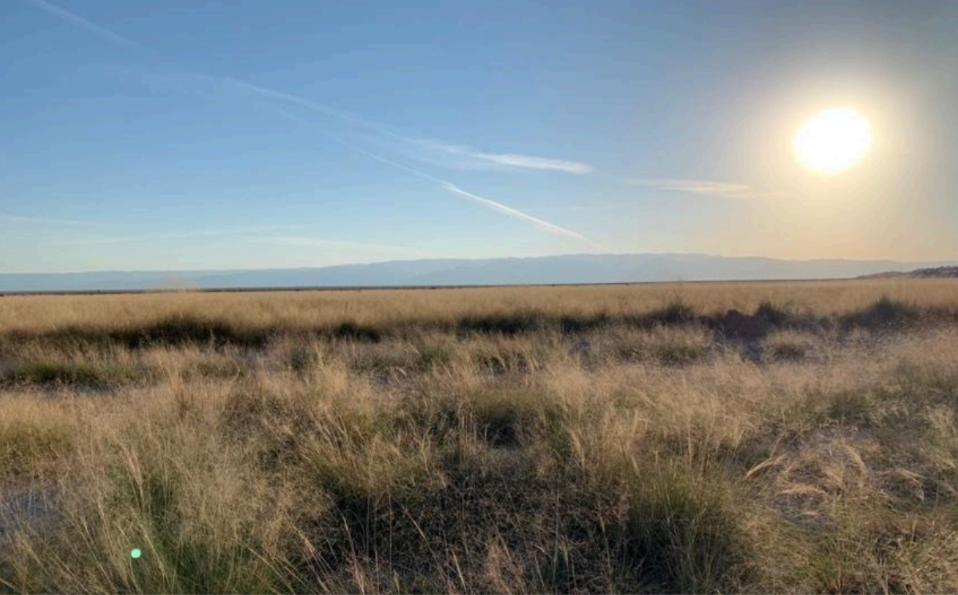
Although he heavily critiqued the National Park Service, Abbey might have appreciated this park: it has unpaved roads further in—packed sand instead of asphalt—composting toilets, and miles and miles of open sand, only some of which is footprinted.
Whether still or moving, the wind patterns grasses and sands alike, wave after wave that warps proportion. The light and shadow on the sand reveal both stillness and movement—the wind has swept them smooth in some places and made liquid-looking ridges in others.
Solitude here is qualified: there is no one nearby, but I know there are many people in the park.
Light and color clarify what has passed and what stays present.


As the day begins to heat up, I drive back up into the mountains, through the tunnel and back into pines. It’s still only mid morning, so I head higher up the mountain, toward Cloudcroft and just past the old railroad trestle to hike the Osha Trail. The first segment of the Osha Trail smells of baking pine needles, like Carmel Valley, California.
Rocky and dry and almost entirely pine trees, it’s warm, 66, but not hot. I can feel the altitude pressing my lungs, so I take it slowly. I look out from this strikingly different landscape at White Sands National Park, a strip of white in the distance, and move carefully along the rocky path, that slowly begins to give way to aspen.

Being among trees is reassuring. It’s the coolness of the mountains, to be sure, but also the relative gentleness of what grows here. To be solitary in the wide open desert is a very different thing from being solitary among tall trees. As the day warms, more people begin to walk the path, and by the time I finish my hike, the parking area is full.
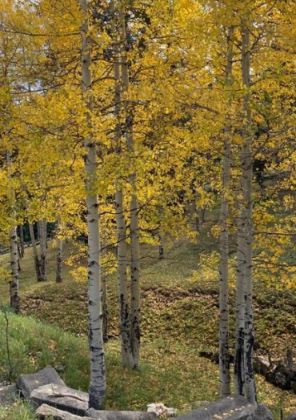

The next morning, before I
leave for Old Mesilla, I drive
back up into the trees,
savoring the colors of the
mountains—and a lone deer.

Semi-solitude in Old Mesilla, New Mexico
I arrive before my Airbnb is ready, so I visit Coas Bookstore in Lac Cruces, the oldest bookstore in New Mexico, and come across a boxed edition of In Nature’s Heart, a collection of excerpts from John Muir’s writings. The book progresses through times of day, like much of Muir’s writing did, starting at dawn, moving through morning, etc., and each set of short quotes is accompanied by a beautiful photograph of a place evoked by the words. Muir is one of the men Abbey references as a pioneer, a perhaps less arrogant, certainly more religious, man fighting for the wilderness. His descriptions of the natural world are filled with awe and wonder, acknowledgment and gratitude.
I think of the wonder of his descriptions as, each morning, I get more accustomed to the desert, less afraid, and amazed anew at the coming of light into the cool of the morning. The light is different every day, and the draw I feel to watch it becomes deeply compelling. There is a kind of yearning, as Abbey and Muir also describe, to witness and be in the presence of that changing light and to watch it in solitary silence—a way of being with a life force while also being alone. The intersection of light itself and attention to it invite a repeatedly dawning and ever-deepening awareness of already being and always newly becoming.
Dripping Springs
The first park I visit from my casita in Old Mesilla is Dripping Springs, an area of the Organ Mountains-Desert Peaks National Monument. It is early, although not pre sunrise, and as I walk toward the peaks, the sun stays behind them, even as it is rising. It’s neither race nor dance. The sun doesn’t care where I am. But I care where it is, because once it crests the mountains, the heat quickly becomes very intense.

In this early morning time, though, the grasses and mountain peaks hold the diffused, not-yet-direct sun rays as those reflect off the clouds. I have that feeling again that everything is coming back into being. In fact, it is simply coming back into perception; it never ceases to be. I find its shifting presence increasingly awesome.
Abbey writes that “the desert lies beneath, and soars beyond, any possible human qualification.” That rings true, and as I spend more time in it, and I begin to feel what compels people
My friend Alice uses the words vast, austere, and abiding to describe the pictures I send.
As I walk along the gravel trail toward Dripping Springs, I think of Abbey’s critique of national parks and their paths but also of Shepherd’s words about company. Rethinking solitude means, in part, rethinking who has been here before to make my being here possible. I realize that I appreciate paths the most when there’s nobody on them, but still, I have to recognize that I am never entirely alone, because there is a path, and therefore, I am “companioned, though not in time” (Shepherd, 2011, p. 30).

Before the sun comes over the Organ Mountains, the light is soft and gentle, slow to fill in the crags of the cliffs. There are muted bursts of yellow, some curtailed greens, as if color is a secret. I walk through pockets of cool air, although I can also feel waves of warmer air higher up and occasionally washing over. It’s interesting that there’s so much water language for dry air, for dry terrain.
Without the sun on the mountains, it’s hard to have any sense of depth. They look strangely flat, even though I can see ridges and layers. Once the sun is fully up, not only color but also proportion, depth, and distance become more perceptible. I have no desire to scale these crags the way Abbey, and even Irvine, would have. I am content to stand in awe of them as their contours regain depth and clarity.
Trails, even here at Dripping Springs, are just as Abbey predicted: carved out, fairly easy to traverse, flushing toilets at the ranger station. Visiting these spaces is not for me about survival in the wilds of the desert but rather listening to the silence their preservation makes possible, seeing the more elemental, as Shepherd described the Cairngorms in Scotland, attending to what in myself such expanses make discernible.

I am learning that it is in mid morning, when the cool air from the night is starting to mix with the warming of the sun, that the details of the desert terrain are sharpest. As the sun clears the hills, silence becomes absolute, just as Abbey described. The birds and other creatures that used the early light and not-yet-heat to hunt begin to retreat from the soon-to-be-too much heat. With their departure, stillness and silence hold or perhaps just hover around these enormous rock formations.
As the day is heating up, I hike to La Cueva, a cave below the Dripping Springs preserve. The story of the hermit, told on a sign just inside the cave, which is more of an overhanging rock formation, reproduces the notion of solitude Abbey espouses—traveling entirely alone, without any worldly possessions, and living in total isolation. A man, of course. In contrast, I am a woman who could not have survived here alone when the hermit did and am now most certainly one of those people that both Abbey and Irvine criticize: wealthy white liberal who drives to these beautiful places, wanders the trails, gets back in my air-conditioned vehicle, and drives away. That privilege extends to and informs every aspect of my solitude, affording me both the opportunity to travel to this place and the luxury to visit it alone.
Mesilla Valley Bosque State Park
One early morning I drive the few miles from my casita to Mesilla Valley Bosque State Park. It’s the first day that has any wind, which is warm and occasionally carries a few tiny drops of rain, hardly enough to wet the ground. The sun starts to rise just as I approach, so I park my car and climb up an embankment to watch the sun come up over the Organ Mountains, feeling the warm wind wash over me. The clouds make for a soft and colorful sunrise, muted oranges that illuminate the land with warm tones in contrast to the clear, bright light of a cloudless morning.

Being solitary for me is, in part, about having enough silence and space and sense of security to notice and to sit with beauty. Walking through the Mesilla Valley Bosque State Park in the silence with only the movement of the wind gives me time to notice tiny flowers blooming, to let my eyes rest on the contours of the Organ Mountains in the distance, to notice the bending of the grasses, some of which look like diffused sunlight on stocks—finely spun, gold threads that can hardly be captured with a camera.


Picacho Mountain
On a day when the sun is obscured by clouds, I head to the open area of Picacho Mountain, the most arid land I have hiked yet. The preserve is beyond an upscale development at the end of a long sand road that I wonder if my car can handle. Some of the unease regarding my fitness for such solo navigation returns. I manage to navigate the loose as well as packed sand, and mine is the only car in the parking area.
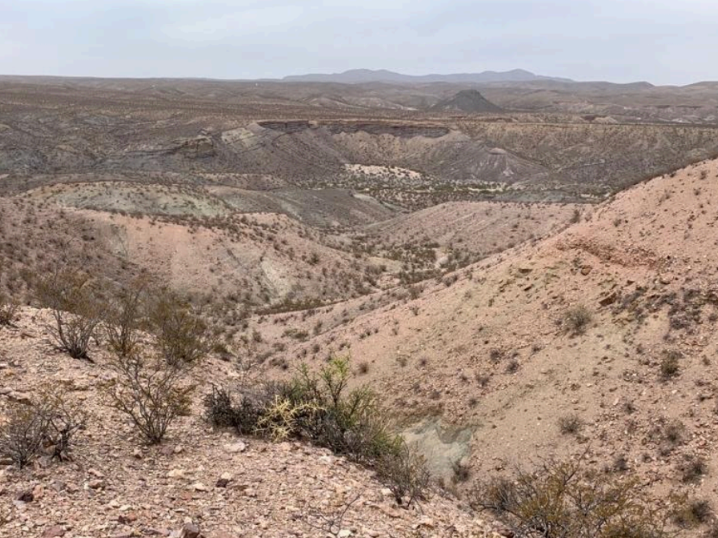
This looks like the land I saw from the plane as it descended into El Paso, and I walk amongst the rocks and shrubs, watching carefully for snakes, as the sign warns hikers to do. It is silent and still, and I am entirely alone. No other hiker comes to traverse these hills and canyons.
According to the recreation area website, the peak is over 9 million years old, which makes it older than the Organ Mountains. Contrary to popular belief, the website continues, Picacho Peak was never an active volcano but was rather formed from flow-banded rhyolite which gives many of the canyons and arroyos a distinctive blue color. I see this strange blue rock as I hike, and I feel how old this place is as I pass through it.
I estimate that I climb about halfway up Picacho Peak—around 2,000 feet—which is high enough to start to feel vertiginous and to worry about the loose rock of the path. The existential dread I felt on the plane and driving from El Paso to Alamogordo intensifies, and my awareness of my solitude settles into a form of worry.
The exposure, the sense of smallness in this vast expanse, the almost complete absence of any other living thing, shifts my feeling from solitary and alive to isolated and vulnerable. The developed areas spread over the land beyond this peak, which I can easily see from this height, do nothing to decrease the sense that I am in danger out here.

On the way down, I take a different path from the one I took going up, and I see several dry streambeds.
As at Dripping Springs, I think about what these must look like after rains and remember Abbey’s descriptions of the flash floods—the water coming crashing through, unexpectedly and at great speed. The water’s tracks are clear, the curves it carves in the sand and rock that look gentle and graceful but that I can imagine also rush
fiercely, as harsh in speed as the land seems in stillness.
Soledad Canyon
At the end of Soledad Canyon Road, to the east of Dripping Springs, two trails start from a small parking lot: Bar Canyon and Soledad Canyon. The Bar Canyon trail gently winds through the dry creek beds and gold fields of grass. When I first arrive around 8:00 a.m., it is cloudy and blustery. I wear my jacket for the first time, and the wind and occasional rain buffet me as I walk up the trail. I see several kinds of wildflowers I haven’t seen before, brightly blooming among the rocks:


I meet a woman and her dog, and she tells me about other hikes she has taken in this area, including along the high, rocky ridges of Bar Mountain, with her hiking club. This makes me think about a conundrum of solitude—how some terrain simply precludes it.
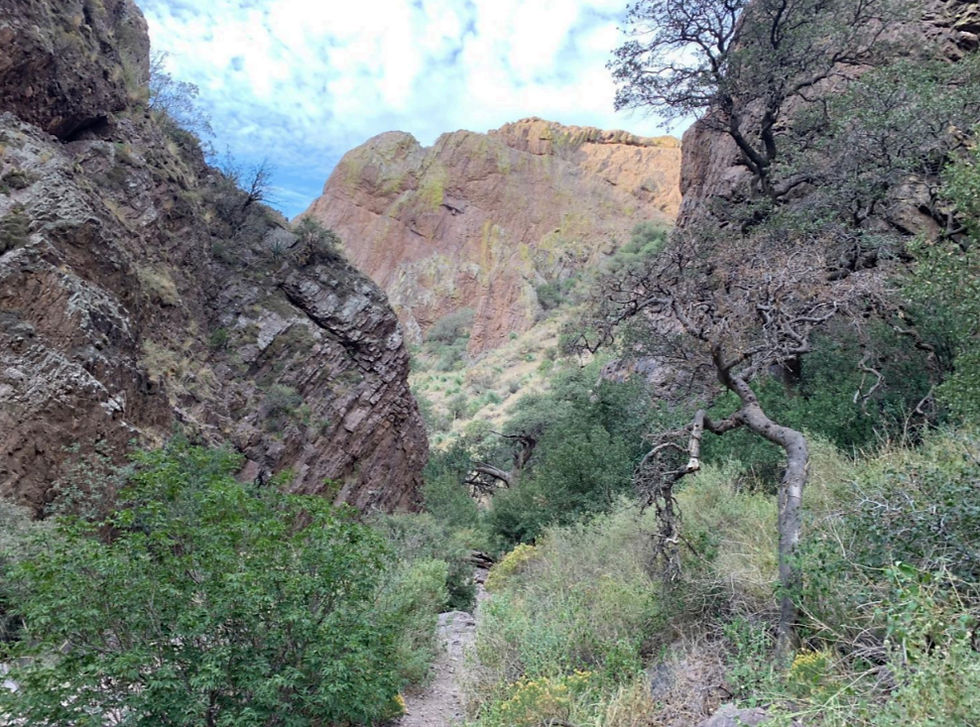
I venture beyond the more well-traveled path in Bar Canyon toward Soledad Canyon. The signs at the ranger station warned of mountain lions, bobcats, and other large felines it would be better not to meet alone. I walk here, entirely alone now, as far as I can into the canyon before the trail turns to loose rock and begins to scale the cliffs. I notice more green,

perhaps because after rains there is in fact water here, and I feel more kinship with the terrain. Still, I move among the rocks with a vigilance that differs from my solitary passages n other parks although not the same existential fear I feel in the most arid of landscapes.
When the sun fills these fields, there is a different feeling, a gentler warmth— or else I have simply grown more accustomed to these shifts.
“Soledad” is the Spanish word for solitude.
Bar Canyon Revisited
In the early hours of my last morning, I hear a lone owl hoot. It’s the only sound before the light begins to come up. I hear three hoots, and then silence again. As I am heading out to my car to drive out for one last hike beneath the mountains, I see a falling star. It has the five pointed shape of a star cut from gold paper, with a long white tail, and it falls for several seconds, until it disappears behind a tree. Clouds hang over the Organ Mountains, bilious, cumulous clouds, not heavy fog, and they shift as the light shifts. To see them from as many angles as possible on this last day, I drive out Baylor Canyon Road, off Dripping Springs, where I have not been before.

From the side of the road, I take this picture of the Robledo Mountains in the distance. I did not visit them while I was here, so their ridges are not as familiar as those of the Organ Mountains. But the layers of light, from the suspended clouds down over the mountain ridge to the scrub-covered sands feel familiar to me, as does the awareness of my own presence that these layers bring.
I return to Bar Canyon, and as I hike up and down the trail, I keep looking toward the Organ Mountains, just visible over the closer range of rocks in this canyon, to watch them in the changing light. These mountains are visible from almost everywhere in the Las Cruces area. Over my handful of days here, revisiting them from multiple angles has become both practice of and metaphor for my process of rethinking solitude.
Solitaire in French, Irvine reminds us, can mean “lone wolf.” Cabale means political conspiracy and intrigue but also is imbued, Irvine argues, with spiritual and mystical meanings. In the end, I choose neither Abbey’s solitaire, a game he played

with himself in the wilderness, nor Irvine’s cabal or cabale, her secret group with a common political ideology, in part because my reasons for choosing solitude when I can are not environmental. I respect both Abbey and Irvine for that shared commitment to our natural ecosystems, but my reasons for seeking solitude are personal, a matter of my own survival and thriving, which are threatened when I spend too much time with too many people. I am neither chauvinistic anarchist, like Abbey, nor intentional, respectful, feminist environmentalist, like Irvine, although I have in common with them both loving the wilderness and not wanting it to be destroyed by humans.
Abbey writes about being, in the desert, “at the center of things, where all that is most significant takes place: sunset and moonrise, moaning winds and stillness, cloud transformations, the metamorphosis of sunlight, yellowing leaf, and the indolent, soaring vulture.“ In her revisiting, revering, refusing, and revising Abbey’s ostensible solitaire, person and game, Irvine locates herself more consciously as one who tries to hold “the boundless whole of who we are: paradoxes, half-truths, and all.” My rethinking of solitude of place and self in the desert ecosystem, among and even as one who threatens that community of living organisms, feels like a kind of refinement—an endless process of sifting through sands and senses to discern and to hold more of life and its force and make more space for the paradoxes and complications, such as between fear and awe, and to be always present to and in changing.