What Comes as Gifts: Revisiting Waterways and Water’s Ways (May 2026)

Updated: Jul 17
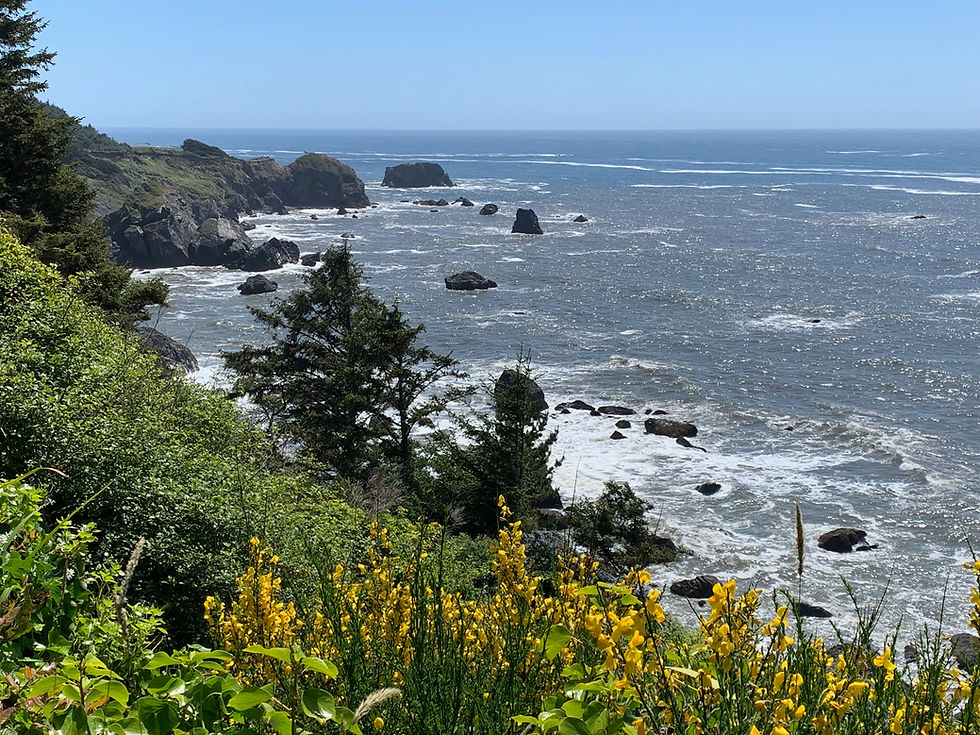
For my first 25 years, I was fortunate to live on or near the coast of northern California—childhood in San Francisco, four years of college in Santa Cruz, one year of graduate school in Palo Alto, several years in secondary school teaching jobs in Portola Valley and Menlo Park. For that quarter of a century, I was never far from the Pacific Ocean. When I moved to the East Coast for doctoral study, I rarely returned to the West’s waters, and Eastern mountain creeks replaced the ocean as my water spirit companions.
Nearly four decades after those early ocean years, my best childhood friend, Erin, contacted me to share the sad news that one of our classmates from elementary school was dying of cancer. Images of that young, energetic girl in the schoolyard flooded back, mixed with sensory memories of the fog enveloping the wind-twisted Monterey cypress and fragrant eucalyptus trees that grow on the bluffs behind the school we all attended together, perched on the edge of the Pacific near Lands End in San Francisco.
Maybe it was that looming life’s end tangled in memories of our early years that prompted Erin and me, after nearly 40 years of only very occasional email exchanges, to revisit all kinds of recollections from our childhoods. We had spent countless hours in one another’s company, at one another’s homes as well as at school.bearing witness to as well as shaping our respective and shared ways of being. Such companionship and witnessing were gifts we gave another, each the only other who had experienced our particular childhoods and each the one we recognized as a spiritual as well as daily companion.
As we shared memories of those times, Erin mentioned always having wanted to return to the Gulf of Naples, where her parents had taken her as a young woman. I said I’d go with her. So, we planned to travel to Italian waters together in the spring of 2026 in honor of Erin’s parents, now both dead, a journey as gift to Erin and to both of us in celebration of life, even as we mourned our childhood friend losing hers.
Transported back to the cliffs at San Francisco’s Lands End, and thinking about the upcoming trip to waters old and new, I decided to reconsider some of the places I have experienced around the world that reminded me of the ocean that shaped my sense of waterways and water’s ways and how those places have reshaped that sense. This story of revisiting reveals not only what has shaped my sensibilities but also what comes as gifts as part of that shaping.
San Francisco, California

On many days in San Francisco, fog engulfs the Golden Gate Bridge. But sometimes the fog clears to reveal the bridge's iconic towers, as in the photo above. That clearing is like a gift: the bridge appearing as if by magic, and the bright blue sky turning the waves of the Pacific from dark gray to deep blue. But just as often fog envelopes the bridge entirely for all the daylight and evening hours, activating the fog horns that echo across the city. The fog can be thick and dense and low to the ground, swirling in ways that make the movement of air visible and sinking its cold through clothing. It’s like water in these ways, although of course not in others (you can breathe in fog), so for me, the waters of the Pacific and the foggy air that often blankets them are inextricably associated. Looking back now, I can see the fog as another kind of gift—an invitation to appreciate the different kind of magic of the water-air.
When I was young, I often walked Baker Beach below Lands End in the fog, listening to the sounding of the fog horns, learning to associate water with wind and crashing waves that threatened undertow and unsurvivable cold. I went to this edge of the water when I felt similarly tumultuous, letting the waves remind me of what is both more powerful and more enduring than my own personal churning. The image to the left of the distant Golden Gate
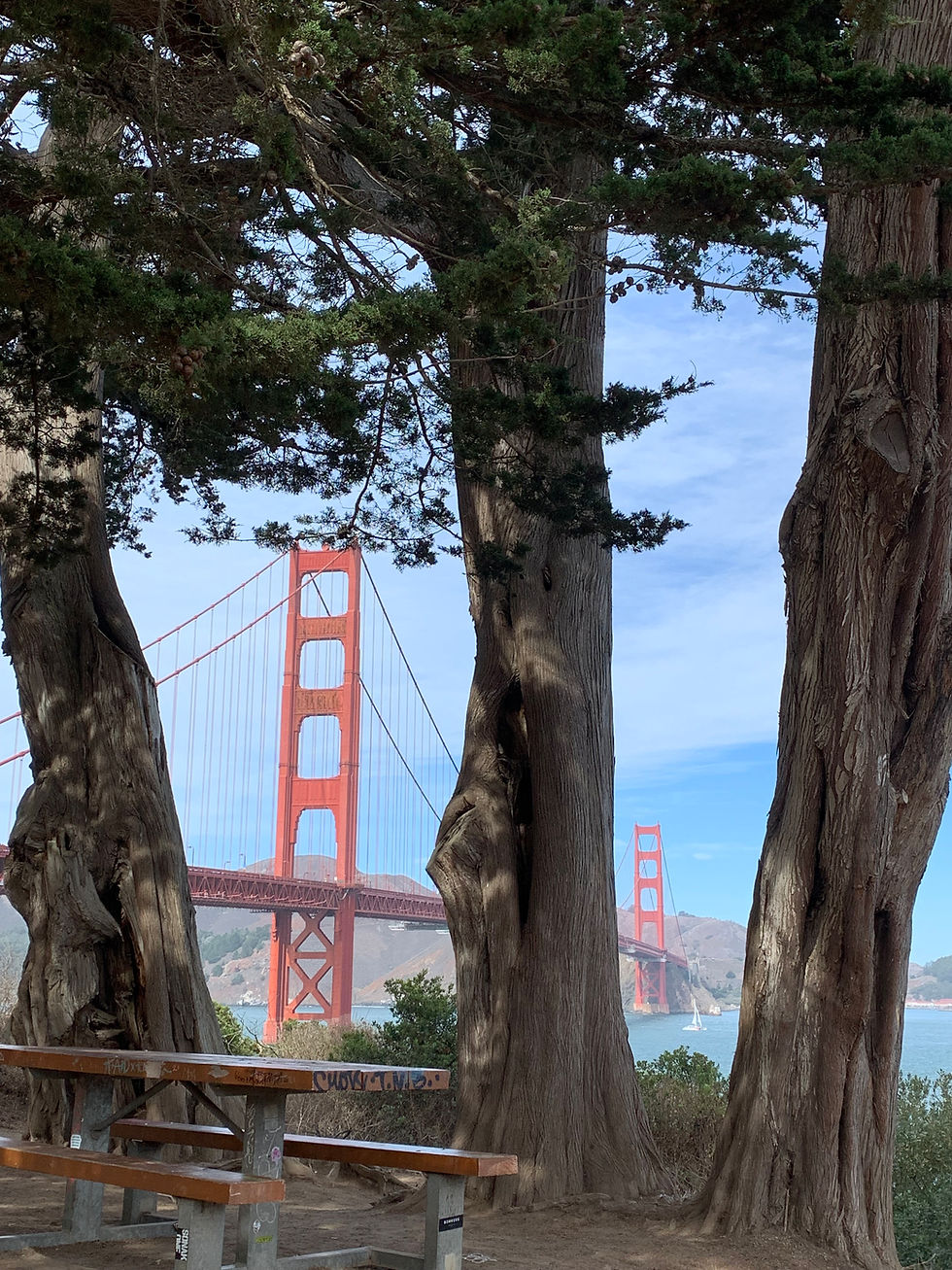
Bridge towers alternating with the closer tree trunks, taken many years after I moved away from San Francisco, captures the layering of space and time I feel having been so long away from the Pacific but always carrying its presence in the feel of fog and wind swirling off its endlessly crashing waters and sudden, unpredictable clearings.
Waters of the South Island, Aotearoa New Zealand
When I visit Aotearoa New Zealand in 2019, nearly 30 years after leaving San Francisco, the hilly terrain on parts of the North Island and interior waters of the South Island immediately remind me of northern California. More the feel than the appearance. On the South Island, I hike Te Tapu-nui, which in Māori means "The Mountain of Sacredness" or "The Great Sacredness." In English, the area is called Queenstown Hill, and at 907 meters, it affords panoramic views of Lake Whakatipu and the surrounding peaks, as in the photo below I take from the Queenstown Hill Time Walk, a trail that leads from the town into the hills.

While some aspects of the landscape around Queenstown remind me of northern California, there are also striking differences, like the quality of the light, which makes everything look a bit surreal. It is as though the land masses are floating on the water, the clouds hovering so close above that they make the sky seem low. It’s a striking contrast between the seemingly wide-open space and the strangely compressed feeling of the water, sky, and land. On the day I hike, it is warm and still, no cold and fog-drenched wind as near the Golden Gate Bridge on the Pacific Ocean.
While growing up, I didn’t think about water (or much of anything) as sacred. But learning the little that I do about the ways of the Māori, I begin to understand both waterways and water’s ways as forms of the sacred. Aotearoa New Zealand was the first to recognize the Whanganui River as “an indivisible and living whole,” as the New Zealand Parliament characterized the river in 2017 in acknowledging its legal rights, “incorporating all its physical and metaphysical elements.” In a country of such sensibilities, it would be difficult to remain inattentive to the interrelatedness of all living and inanimate things—not to feel and honor a kinship relationship.
This relationship extends to some forms of gift giving, as of the pounamu or greenstone that is gathered from the rivers of the South Island and carved into sacred forms by the Ngāi Tahu iwi. One should not purchase one’s own pounamu, only buy it as a gift for others, reinforcing kinship and reciprocity. The stone is believed to connect the person who wears it to the land, to their family, and to their ancestors. When the carved stone is passed down through generations, it gains mana (spiritual power), deepening the connections. These stone-carried connections make me think of how I sometimes bring home with me a stone I have found on a beach by the Pacific (or another body of water), and it makes me wonder about the spiritual connection carried through water-washed stone.

One of the places that pounamu is gathered is near Milford Sound, pictured above. It rains a lot in Milford Sound. That’s what creates the waterfalls, visible in the photo above, that run down the sides of the cliffs. Websites accurately describe this place as a stunning combination of mountain peaks, ink-dark waters, and dramatic forest-clad cliffs. The day I visit is cloudy and gray, but the water of the sound and the waterfalls coursing down the sides of the cliffs are still stunning, awesome—but not daunting and dangerous like the coast of California. The sound’s dark stillness invites a different kind of reverence than the crashing waves at the edge of the Pacific.
The word “sound” has always struck me as synesthetic, since it evokes something heard but refers to a body of water—specifically, a coastal, sea-level body of water smaller than a sea. A sound is protected, so the ways of the water are calmer. I feel water’s way here as a deep and reverent holding—of the rains that constantly wash down the walls of the sound, of the sacred pounamu gathered and carved by the indigenous peoples of the island, of space that feels as much liquid as solid.
Howth and the Irish Sea

Because of my work with the Higher Education Authority in Ireland, I have visited Dublin a couple of times a year since 2024. Each time I visit, I take the train out to Howth, a village east of central Dublin, where there is a walkway that hugs the cliffs above the Irish Sea, affording vistas like the one above. Here it is the seagulls that remind me of Lands End in San Francisco, their cries immediately transporting me back to the foggy cliffs above the Pacific. Sounds, like smells, seem to erase linear time, bringing something long past so immediately into the present that the perceiving mind and body are not sure where they are. I feel this way hiking the Howth Cliff Walk, hearing the seagulls, smelling the ocean, recalling my younger self in San Francisco, but knowing my current self to be in Ireland.

I haven’t hiked the Howth Cliff Walk in the wind and fog, and I imagine that doing so would be unwise, given that there are no railings or other guards to protect one from tumbling down the sheer cliffs to the rocks below. I feel here the fear the ocean has always inspired in me born of its vastness and violence, its icy indifference, at least in these northern climates, and at the same time its awe-inspiring beauty.
Whereas in Aotearoa New Zealand the solid and the liquid seemed less clearly distinguished, here, as at the edge of the Pacific, they feel palpably clear and distinct.
In Dublin Bay, they feel less clear and distinct. The high and low tides at the Pacific beaches near San Francisco can mean the difference between a beautiful stroll and a life-threatening excursion along the shore. Because of the coves, the tides can cut off return access. In Dublin Bay, the threat seems less great, although the shift between high and low tide is dramatic: between 6 and 11 feet, depending on the moon and the time of year. When the tide goes out, huge swaths of wet sand are left where there had been water. People walk their dogs, children play, and it’s as if a whole different landscape replaces the waterway that had just been present. I take the photograph below on a cold day in November, when the tide is out. The only color other than grey is the pale peach of the sky above the hills of Sandycove. Sky, clouds, land, water, and rocks on the foreground seem distinguished only by texture. Still and monochromatic, unlike the coast of California, the cold here nevertheless reminds me of the San Francisco wind that chills and a kind of dampness that soaks in deep. I feel no wildness here, no spiritual connection, no particular insight into nature or myself. I gather no water-washed stones. But I do feel the continuity between the bay of my childhood and this bay in a very different coastal country.

Minori, Italy
I carry all these associations with me to Italy in May of 2026, where Erin and I had planned to meet in Naples and spend our first few days in Minori. She is delayed in meeting me, however, so I spend my first night in Naples on my own and head to Minori the next day. To get to Minori without a car, one can either take a bus over the treacherous and terrifying mountain roads (not recommended by those who have traveled before) or take ferries. I choose the latter, and I set off from Naples on the first ferry to Minori, which departs from behind Castel Nuovo in Naples, below the medieval Castel Sant’Elmo on the hilltop.
As the ferry pushes away from the pier, I feel my first departure from the wheeled and winged travel I have experienced since leaving the US. Not being a sea-going person, I feel a palpable sense of disconnecting from the ground I typically traverse when a boat pulls away from the shore. The feeling of release is also tinged with fear.

I am basically afraid of deep, wide waters. For all the years I spent near the Pacific Ocean, I never went on its waters in a boat, and even being at its edge always scared me in the way the vast desert of southern New Mexico scared me—the miles and miles of arid land, flat and treeless, terrified me like the vast expanse of oceans, prompted the same deep dread of desolation, exposure, and death. That awareness of my love of life also feels like a gift.
The waterways in and out of the Gulf of Naples are well used, with ferries and other boats coming and going constantly. The further we get from the piers, the deeper blue the water becomes, unbroken even inside the bay. As the ferry boat cuts through the water, I think about jet streams that airplanes drag across the blue of the sky, or leave invisible, as on the plane on which I flew through the darkness. Evie, the oceanographer in Richard Powers’ Playground, describes how her colleague can discern the pathways of boats in the water even long after they have passed. This is not the obvious white water churned up in the wake of a speeding boat, as in the bottom corner of photo below; it is a perception of water’s way of holding motion that only those who spend their lives on water would notice. I discern only its vast expanse and the waves set in motion by passing boats and the wind. And I’m glad for the silhouette of the Sorrento Peninsula, offering a buffer from the Tyrrhenian Sea.

Once we round the tip of the Sorrento Peninsula, the sea opens out to the right, and we pass cliffs and towns, some of which we stop at—Positano, Amalfi—until I arrive 2 ½ hours later at Minori. The oldest inhabited site on the Amalfi Coast, Minori’s name is derived from the name of the stream that runs through the town, La Rheginna (Reginna Minor), and, according to Wikipedia, dates back to the Etruscan or Greek ages.
Approaching Minori, I have the opposite feeling of pulling away from Naples. Moving toward the familiarity of land, I watch the swath of water shrink, and I feel what I perceive shift back into dimensions, proportions, and a medium I can better comprehend. These departures and arrivals on water bring into greater clarity assumptions about the naturalness (to me) of the elements, their relationship to one another, and my relationship to them. Another gift.

Unlike Positano and Amafli, which teem with people, Minori is not overcrowded.
People fill the restaurants on the square on this holiday afternoon, but there is room to breathe and to move.
The caretaker of my Airbnb meets me down at the pier, and we walk up through the town. She points out different landmarks and stores, most closed since it’s Sunday,
Within a few minutes we are out of the downtown area pictured above and walking along La Rheginna, apartments and houses on either side of the narrow roadway.
My Airbnb perches, like most houses here, on a steep slope; there are more than 50 stairs to get to the front door. All across the hillsides and shading portions of the garden are groves of lemon trees, planted in tiers up the sides of the steep slopes. From my patio I hear La Rheginna that runs “from the mountains to the sea,” the website for the town explains.
Just below my house, La Rheginna runs alongside the road in a concrete channel with regular drops that make waterfalls, as pictured to the right. This channel is not what I associate with the natural course of a river, and it isn’t natural: it was constructed to contain and make the waterway of La Rheginna usable to the people of the town.


From the patio and bedroom windows of my Airbnb, pictured to the left, there is a view of the downtown I approached by ferry, with the tower of The Basilica of Santa Trofimena, and, beyond, the Tyrrhenian Sea. Every hour brings a different quality of light to sky and sea.
On my second day, I walk the Sentiero dei Limoni (the Path of the Lemons), which affords all kinds of vistas of the Tyrrhenian Sea. I leave before dawn, hoping to catch the soft colors and miss the heat. I see many cats and only four other people on the trail, two tourists and one woman who lives in a house along the path taking her daughter to the bus stop.
The sky and water look more similar than different today. While the horizon line is visible, the color palette shared by sky and sea makes the two elements appear to blend into one another where they meet. The gift here is of this peaceful shading of colors that complicates my sense of difference and sameness.


On the walk back along the Sentiero dei Limoni, the sun rests full on the town, the Tyrrhenian Sea like a sky-blue backdrop. I am struck by the similarity between the color of the roses growing in wild bushes along the path and the town’s buildings—a pale pink and ivory white that is also the color of the skies I see in early morning. Although it is hot, there is a softness here, of color and light, a warmth that is not about temperature but about tone. It’s a stark contrast to the cold greys, deep greens, and dark browns of Ireland and Aotearoa New Zealand and of northern California as well. These differences make me wonder about what is discernible with contrast and what is discernible with congruity.
On my last morning in Minori, there is a soft sunrise—pale pink clouds over the Tyrrhenian Sea. The lights in the bell tower glow in the predawn, adding to the sense of soft, suffused light. I realize that I have only seen the sea calm, seemly almost still from this distance, itself more like light than water.

The land masses encircling this sea would make it less wild in a storm than the open ocean. I am grateful for the stillness without that inspires a stillness within. Like the sunrise, the quiet of the morning water and this overcast day are full of the gifts of rest and calm.

As I wait for the ferry to take me to Sorrento to meet Erin, the sea is yet another color shade of grey-blue to match the clouds. The waters of the Tyrrhenian mirror the quiet of the town. In the distance is the Puglia peninsula in silhouette, and closer, the empty waters beyond the Minori beach are dotted with buoys for mooring boats.
Returning to the Gulf of Naples
Erin and I stay outside Sorrento in the quiet town of Massa Lubrense. A series of three rooms, each with windows onto the Gulf of Naples, our Airbnb is near the end of a long, steep street, perched on the cliffs. We have a view of the gulf and the island of Ischia.

Every morning and sometimes for much of the day, we sit on the balcony, pictured to the left, watching the light change the waters of the bay, listening to the waves lap against the rocks below, moving through our stream-of-consciousness revisiting of childhood memories.
We are the same and changed—the timbre of our voices as familiar as the rhythm of the waves, but older; our awareness and our sensibilities deepened.
Below our cliff dwelling is a rocky beach with a view of Capri in the distance. We walk from this beach to the nearby harbor for dinner, to shop for food, and to catch the boat we book to revisit Capri. The waters in the gulf are calm except for one day of storm, clear and gently rocking.


On the beach we find worn pieces of tile, like ceramic sea glass, scattered among the rocks or gathered by previous walkers and left in new patterns on the larger rocks. Each of us takes one of these fragments home as a memento—a gift from the sea by which to remember both this moment and all the moments that came before.

We take small tour boats not only Capri but also Ischia and Procida. The day of the Capri trip is clear and still, affording glimpses of calm grottoes—blue, green, and white—like the one pictured above. On the day we visit Ischia and Procida, the gulf grows stormy, and we are reminded of the power of the wide waters to toss us as easily as it did the ceramic fragments we gather.

Because I am used neither to being on the water or, at this point in my life, with Erin, there is a surreal quality to crossing the gulf in small boats, sitting beside Erin as we pass islands from the past and ones we’ve never visited. Everywhere we go, memories flash like reflections off the water and flow into words that both retrieve and remake the past. I am surprised again and again not only by what Erin recalls but also by how she remembers. She fills in details of her life I wasn’t aware of as a child, and she recasts my memories of my own family in ways that give me a new version of them, and myself, to carry forward.

I take the photograph to the left when we disembark from our boat on Capri. Erin swims in the sea, and I ponder perspective, space and time.
The knotted driftwood in the foreground was perhaps shaped by years of rolling among the rocks of the wave-washed beach below. It seems larger than the Faraglioni in the distance— limestone sea stacks the tallest of which rises as high as 360 feet from the Mediterranean.
From this angle, the Faraglioni look small, far behind the water-sculptured wood, held between expanses of ocean and sky.
Back on our boat, we round the southern coast of Capri and approach the Faraglioni. We are in wide open waters here, and these stable stones also seem surreal—impossibly big when we are directly underneath them. The wonder of these limestone sea stacks is matched by the wonder of Erin's and my reuniting, two quirky and creative kids grown into strong and successful women working in very different worlds who exchanged the gift of friendship in a city by an ocean and a bay that we choose to revisit after 40 years.

These visitings and revisitings of waterways and water’s ways not only juxtapose places of contrasts and places of complements. They also clarify how I experience myself in these different places as well as across time. And they illuminate what I perceive as gifts. Growing up in San Francisco, it was always contrasts and hard edges, differences, sometimes clashing, sometimes clarifying. The daily and spiritual companionship I had with the ocean and with Erin were gifts that animated my life as a child.
The new waterways and ways of water I’ve learned through visiting places similar to and different from the coast of northern California have helped me slow down, to wrestle less, to notice subtle variations within a single palette across elements, to consider gentle stillness as well as ebbs and flows of crashing tides. The full circle of starting in San Francisco, on my own and with Erin, then returning to the Gulf of Naples, shows me through water’s ways of being our own similar and different ways of being in and over time.
The open waters, whether seas or sounds, remind me, too, of the waterways I’ve chosen in later life, particularly a creek I visit every time I go to the Endless Mountains of Pennsylvania. Walking along the banks of this creek, pictured below, I appreciate the water's steady song, the uninterrupted stream of bounded sound that I can better comprehend than the expanses and the crashing cycles of ocean tides. Like the gifts of age and perspective, these are not automatically given. They come through spiritual connection with natural—and, sometimes, human—companions.


