Resounding Lejana y Sola (July 2026)

Updated: Jul 17

When I was learning Spanish in elementary school, my teacher had us sing songs and memorize poems. I still remember some of them more than 50 years later. I recall them when I encounter reminders of their carefully chosen words or wider references.
I had not thought of Federico Garcia Lorca’s poem “Córdoba,” one of the poems she had us memorize, until I see the place name on the map as I am flying to a conference in Madrid in 2026, the 63rd year of my life. I had always found haunting the lines with which the poem both opens and closes: “Córdoba, lejana y sola” [distant and alone]. But the poem itself had not spoken to my experience; it is about a man’s worldly aspirations, inevitable failure, inexorable movement toward death. Gloomy and fatalistic. Reconsidered in the light of my starting, at 60, to take solo trips, compelled by the prospect of solitude in distant locations, the two linked words that begin and end the poem feel entirely different to me than Lorca had them feel to his doomed horseman riding toward Córdoba, knowing he will never get there or achieve his aspirations. To me, the words lejana y sola evoke the possibilities of being present and aware in a faraway place, open to the possible, on my own and alive.
After the conference in Madrid, I fly to Mallorca for a second conference—one to which I submitted a proposal because the event was so close, in space and time, to the gathering on the mainland of Spain. The flight from Madrid to Mallorca takes an hour, and from the Palma airport it’s a 40-minute drive to Banyalbufar, where I have rented a renovated fisherman’s house with a view of the famed terraces that cover the steep slopes of the Serra de Tramuntana mountain range, descending toward the Balearic Sea. Lorca’s lines return to me, and I settle into a joyfully solitary re-sounding of lejana y sola in this particular faraway place.
Arriving in Banyalbufar

I had been compelled by the images of the house perched on the slopes of this town—its blue door and white walls, its views of both mountain and sea, and its proximity to Palma—rather than intentional in choosing Banyalbufar. I learn upon arriving that this is one of the last original villages on the west coast of Mallorca—a quiet municipality of 580 residents with a few shops, very little traffic, narrow streets winding down to the water or ascending, like the ones in the picture to the left, by long flights of stone stairs.

The name “Banyalbufar” is a blend of Arabic and Catalan influences meaning “built by the sea.” The step-shaped constructions that cover the slopes of the Serra de Tramuntana, called “marjades,” were created in the 10th century during the Moorish occupation of Mallorca. Captured in the photo below, taken from my west window, the marjades were designed so the inhabitants could plant on this otherwise inhospitable terrain as well as capture the water flowing from the peaks of the mountains down to the sea.

Although agricultural practices have largely, although not entirely, been replaced by vacation villas, the dry-stone construction of the terraces remains visible and reminds me of the mortarless stone walls in the west of Ireland, designed to let the wind pass through. The deep understanding of the elements and how to work with not against them feels to me, here and in Ireland, like what hope and endurance are made of.

On my first evening in Banyalbufar, I walk down to the cliffs at the edge of the Balearic to watch the sun set. Another heat wave has settled on Spain, and it is in the high 90s. A slight breeze off the sea blows the hot air through the dried grasses, and I stand as still as I can, waiting for the sun to sink beyond the horizon. Stalks of pastanaga borda (Queen Anne’s lace) bloom from the rocky cliffs, somehow surviving on sunshine alone. Seagulls perch on the craggy limestone of the cliffs, and gentle waves splash against the boulders below. This land’s end, abrupt and harsh, is a particularly stark form of elemental, softened in the evening light.
The sunset blends color and shadow, half the sky streaked with orange and yellow like a Turner painting, while the other half is darkened by a thick cloud hanging on the horizon. A single sailboat glides on the still water, also lejana y sola. At once final—the definitive end of this particular day—and also part of a cycle of days, the sunset is a visceral reminder of time and space, as if the horizon were the place those two meet.


On my long, slow walk back up the steep hill to the town, I encounter a single, grazing horse, seemingly suspended between his rock-ringed pasture and the Serra de Tramuntana mountain range in the distance. We observe one another, two solitaries, noticing.
Walking Sa Volta des General
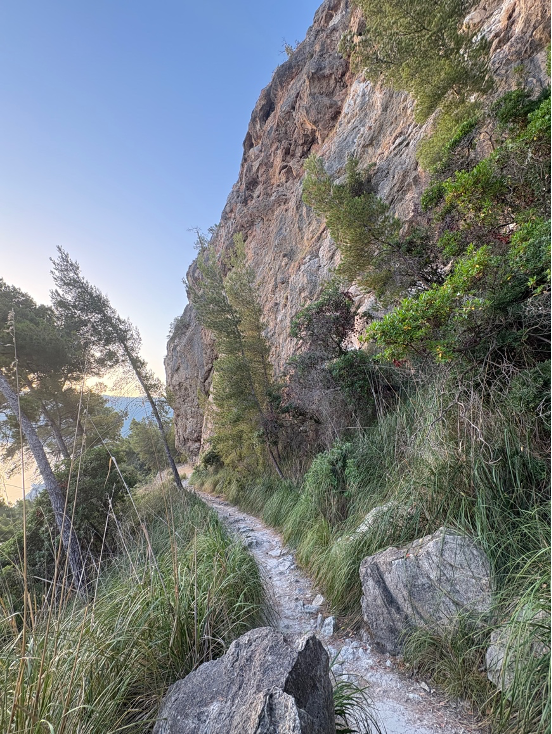
On my second morning in Banyalbufar, I rise before the sun and drive to the trailhead of Sa Volta des General. This trail winds between the Balearic Sea and the looming foothills of the Serra de Tramuntana. Scattered pine trees and rockrose, myrtle, and other bushes, mostly crisp and dry in the summer heat, cling to the steeply sloping land. At 6:00 a.m. it is already 80 degrees, and I don’t meet a single other hiker. I am watching for the sunrise but also knowing that the intensity of the heat will immediately increase as the sun peaks over the mountain range, as in New Mexico.

For several minutes the brightness hangs at the top of the ridge, keeping the trees in semi-darkness. The lack of light intensifies the silence of the predawn. It reminds me of the mornings in New Mexico before color poured back into the landscape with the light, seeming to bring all the life into being. It’s a special kind of affirmation to be recreated every day.
The distance here is of so many kinds: the distance to the tops of the cliffs that are so high they are not visible; the distance across the Balearic Sea that is so great there is also no end in view; the distance between me and any other people. Lejana, the feminine form of lejano, is used in precisely these three primary ways in Spanish: in relation to physical space, to time, and to relationship among people.
It is the perfect word for where and how I am here. All three forms feel present on the narrow trail that guides me on my solitary way between high cliff and wide sea.
The scale of the cliffs is hard to comprehend and even harder to capture in images. Sheer hardly suffices. The pines lean away from the massive rock formations, pushed by winds that blow off the land and pulled toward the brightness over the water.
Staying in Es Pastadó
Between the heat and the lingering exhaustion from days of conference going in Madrid, I am tired enough to spend nearly all of Sunday, after walking Sa Volta des General, in the restful cool space of Es Pastodó, the name of my Airbnb. The wood beams painted ivory and the walls painted white balance the views full of color at every portal. To the east, the slot of a window at the top of the stairs frames the bougainvillea with the Serra de Tramuntana behind. The small, square, wood panels in the old front door open onto bright blue plumbago and magenta bougainvillea. And the door at the top of the small staircase across from the house leads to secret garden.


Through the west windows, the sun and clouds make pattern after pattern. I write for a while then move from opening to opening, starting to find familiarity with and feel drawn toward this terraced and too-hot sea town at the foot of the mountains.

Walking to the Torre del Verger
On the first almost temperate evening—only 84 degrees at 9:00 p.m. with a light breeze—I set out to walk to the Torre del Verger, about a mile up the road from Banyalbufar. Built in 1759 as one of a network of sighting towers to protect against pirate attacks from north Africa and the Ottoman empire, this tower is considered the most iconic along this stretch of coastline. The name Verger means “orchard” in Catalan, and all along the road to the tower orchards line the terraces, with the changing sky above the Balearic Sea beyond. Walking this way, I get a different angle on Banyalbufar, a perspective from a distance, standing alone on the road and looking back at the town where I am staying. It seems established, nestled, safe and secure, the clouds pulled above like blankets. I, not the town, am lejana y sola.

The soft air blows through the stands of pine along the road, making that sound more like rushing water than moving air, reminding me of the same sound in Scotland, in Carie, Perth and Kinross. With more clouds today, the light is gentler, making the sky feel at once bigger and closer and turning the water a dark, gray blue.

The Torre del Verger itself is unimposing, more for looking from than looking at—
a privileged perception on my part born of not having to watch for pirates.
The cliffs below drop straight to the sea, accenting the potential for long-distance surveillance.

Hiking to Port des Canonge
This morning I set out even earlier, while it is still mostly dark, to make the longer hike from Banyalbufar to Port des Canonge—7 miles round trip. I know my way this time, since the first part of the hike is the Sa Volta des General I already hiked on my first day. The light and landscape look different, since it’s a little earlier, but still familiar, the craggy cliffs appearing a bluish-white in the low light of early day.
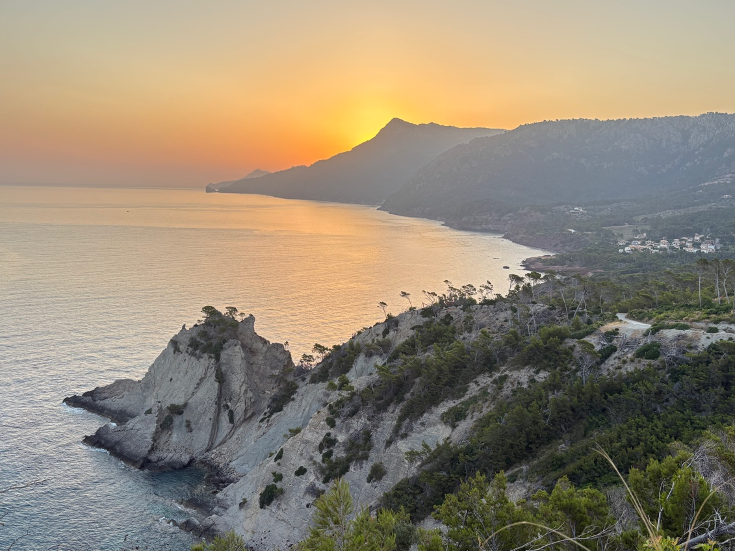
As I descend toward Port des Canonge, more of the colors of rock, water, and sky begin to fill in, the sun holding its heat but starting to spill its light into the coves and crags of the limestone cliffs.

There is good signage, making it possible to focus on the experience of hiking through the stands of pine, silent in the early morning before the cicadas start up. There is no wind, so the only sound is of the waves crashing gently on the rocks below. As I walk, sounds blend like light. The waves crashing, captured in and thrown out again by the huge overhanging cliffs of the foothills of the Serra de Tramuntana, mix with sounds of the wind blowing through the pines. It is difficult to tell which sounds are of water and which of air. I don’t enter the town of Port des Canonge itself, staying out by the cliff’s edge instead, lejana y sola, watching the sun crest the hilltop and illuminate the dried grasses and flowers, as seen below.

About noticing the tracks of animals that had passed in the wilds of the Cairngorms, Nan Shepherd wrote that “one is companioned, though not in time” (p. 30). I feel a different kind of companioning in the peaks of the Serra de Tramuntana, here behind the wind-blown pines and the stalks and flowers of pastanaga borda.
This companioning is a slowing to the stillness that the towering cliffs seem to embody and to invite. I remember first being daunted by and then being drawn to the Organ Mountains in southern New Mexico, compelled to return to them each day in person or just to seek them out in the distance. They became spiritual companions, not explicitly guiding, as some people do, but being by example—their unchanging stillness (at least unchanging in the short time I observed them; they certainly change over years and millenia), only made different by the ever-changing light.
I don’t miss the mountains when I leave. It’s not that kind of companionship. It’s companionship in presence, in the present moment, spiritual as well as physical in how it calls for abating, attending, revering, re-binding (religare—the root of the word religion). As in Scotland, the re-binding is for me to the abiding life of natural entities that are present without expectation and eloquent without speech.

When I turn to start back to Banyalbufar, the sun has crested the cliffs and is heating the red soil, the result of high iron content, ancient river deposits (made millions of years ago during the Permian period), and oxidation. It’s a stark contrast to the cooler color and feel of the Serra de Tramuntana.
Looking up at the distant range beyond the pines makes me draw deeper breaths, compelled by what, at this distance, looks like stillness and solitude.
Sunrise at Torre del Verger
On my last morning in Banyalbufar, I walk the nearly empty road toward Torre del Verger. As on the previous mornings, the rising sun, still behind the Serra de Tramuntana, spreads a slow pink and orange glow across the eastern sky. There is again a slight breeze, and the dry grasses have the baked smell of holding the heat from the day before. When I rounded the last curve of the road toward Torre del Verger, I literally gasp at the sight of a beautiful full moon hanging over the coastline.

I recall that in “Córdoba,” Lorca uses the “luna grande” [big moon] as a symbol of danger, impending doom, and death. In the poem, the moon illuminates the path of the horseman riding toward Córdoba, but it also makes him visible to death, waiting in the distance. The full moon here appears to me peaceful and benign. Like the mountains over which it hangs, it invites
contemplation, not directly—neither moon nor mountain range speaks as a human companion might—but simply by being present, far away, and alone, matching my own feeling of distance and solitude because I choose them. Of course I am moving toward death—everyone is—but I hope it is not waiting for me in the next city, as it was for the horseman heading to Córdoba. I hope I will travel to other places, distant and alone, and find in those places and in myself that appreciation—the slowing down and attending—that presence can foster in the moment and beyond. I hope that the resounding of the two linked terms lejana y sola will also continue to be a re-sounding.